


Discover when to create video content based on 2,200+ Google searches. Learn how search intent, industry, video length, and YouTube influence video SEO.
Video has become an increasingly prominent feature of Google Search, but that does not mean every keyword warrants a video.
For marketers, the more useful question is not whether video is popular, but when Google determines that video is the right format for satisfying a searcher’s intent.
To explore this, the video research team at WayaFrame, an AI-powered video creation and marketing platform, analyzed more than 2,200 Google searches across a broad range of industries and search intents.
The goal was to identify the patterns behind video visibility and provide marketers with clearer guidance on when creating video content is likely to make sense for organic search visibility.
Continue reading to see what the research revealed.
Related Study: The 2027 State of SaaS Videos: How SaaS Websites Are Using Videos
- Key Takeaways
- The Research Question
- The Big Finding: Video Appeared on 61.7% of Searches
- Search Intent Is the Strongest Broad Predictor of Video Presence
- Informational Searches Are the Strongest Broad Opportunity
- The 93.8% Finding: How-To Searches Are the Strongest Video Signal
- Definition Searches Reveal an Important Contradiction
- Search Intent Needs to Be Decomposed Into Searcher Tasks
- Comparison and Best Searches Are Another Major Video Opportunity
- Commercial Searches Are More Video-Friendly Than Many Marketers Assume
- Transactional Searches Have the Weakest Major Video Presence
- Navigational Searches Are Also Relatively Weak
- A New Video Opportunity Hierarchy
- Industry Changes the Video Opportunity
- Entertainment and Media Have the Strongest Video Environment
- Technology Has a Strong Video Opportunity
- Healthcare Is a More Complicated Video Market
- Law and Insurance Show the Lowest Video Opportunity
- Video Is More Common When the SERP Contains Fewer Traditional Organic Results
- Optimal Video Length: The Median Ranking Video Is About 10 Minutes
- YouTube Dominates the Google Video Landscape
- What the Study Means for Businesses
- Final Thoughts on When to Create Video Content
Key Takeaways
- Video appeared in 61.7% of the Google searches analyzed
- How-to searches had the highest video presence at 93.8%
- Transactional and shopping searches had much lower video presence at 32.3% and 31.3%
- YouTube was the top video-hosting platform in approximately 94% of searches with video
- The median top-ranking video was around 10 minutes long
The Research Question
The study asks, when should you create video content for organic visibility?
More specifically, the research investigates whether Google’s decision to surface video is associated with:
- Search intent
- Specific keyword language
- Industry
- Organic SERP composition
- Video hosting platform
- Video duration
- Video age
- Cross-platform video presence
The objective is not to determine Google’s ranking algorithm. Instead, we want to uncover observable SERP patterns that can help video marketers make data-driven content-production decisions.
The Big Finding: Video Appeared on 61.7% of Searches
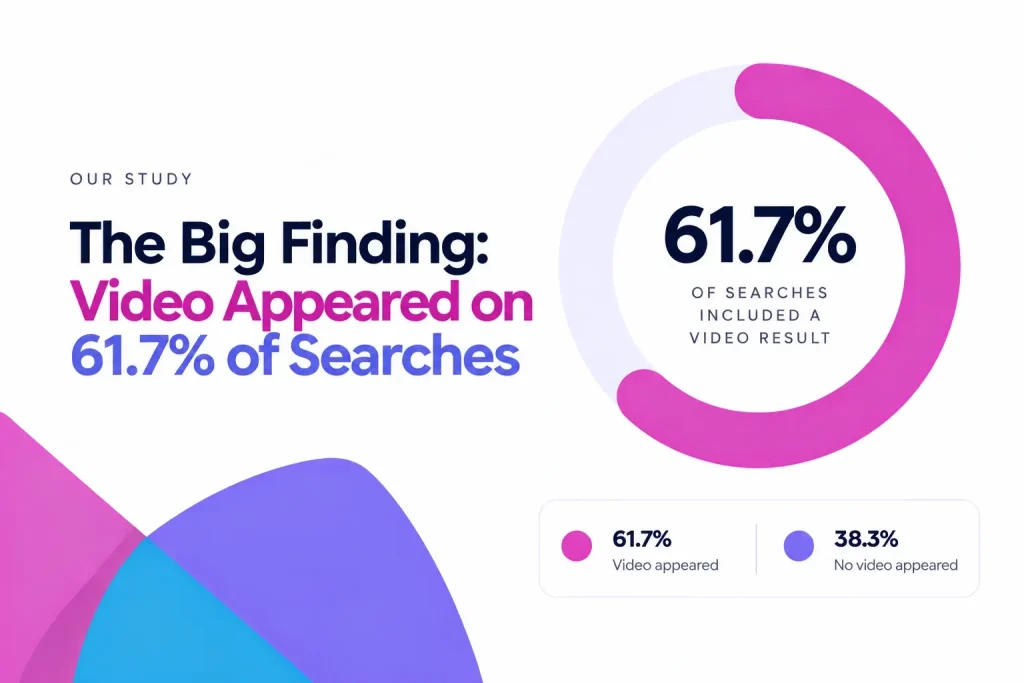
The biggest finding from the study is how often video shows up in Google search results. It appeared in 61.7% of the searches we analyzed, so roughly three out of every five searches included at least one video result.
We found that videos appear across a broad range of industries and search categories, including technology, finance, education, automotive, healthcare, real estate, marketing, manufacturing, travel, food, beauty, home improvement, law, insurance, gaming, aviation, photography, gardening, parenting, and arts and crafts.
The breadth of these results is one of the clearest indications that video has become a meaningful part of the search landscape.
Our study included video results for searches covering everything from laptop troubleshooting and artificial intelligence to home improvement, fitness, finance, and other practical topics, demonstrating that video can surface wherever users benefit from seeing a process, product, explanation, or demonstration.
However, the 61.7% overall figure should not be interpreted as a universal benchmark for every keyword. The likelihood of video appearing changes substantially according to the underlying search intent, which makes intent analysis far more useful than relying on the overall average when deciding where to invest in video content.
Search Intent Is the Strongest Broad Predictor of Video Presence
The study found a clear link between search intent and video visibility.
Video appeared in 89.5% of informational searches and 82.1% of commercial searches, compared with just 42.1% of navigational searches and 32.3% of transactional searches.
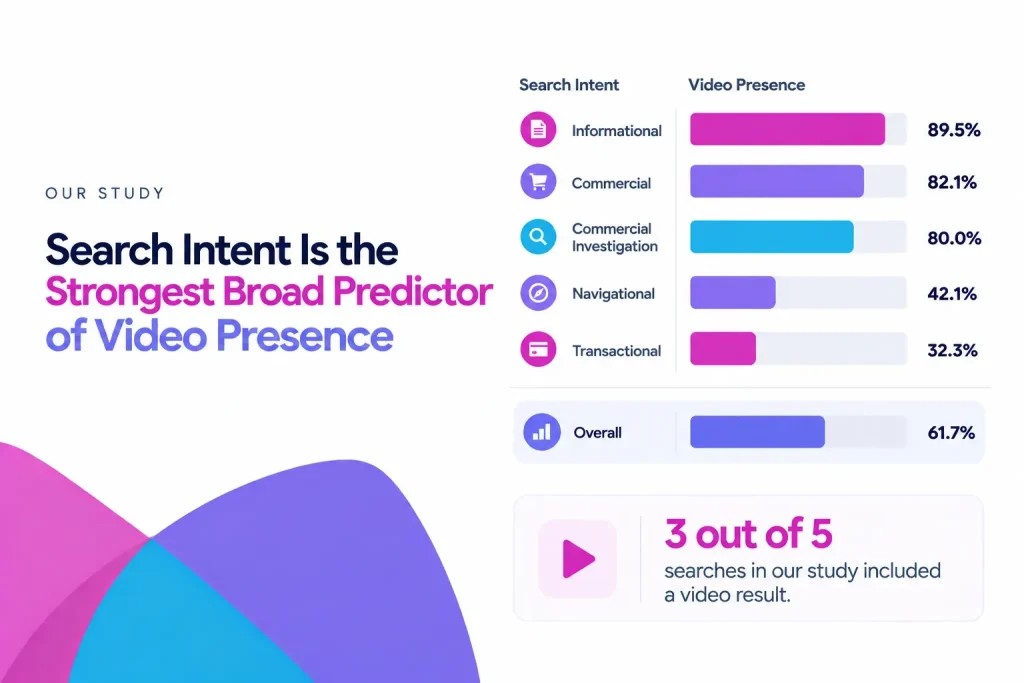
The numbers also show a clear connection between search intent and video visibility. The chi-square test returned χ² = 582.9 (p < 0.001), while a Cramér’s V of about 0.51 points to a strong relationship between search intent and whether video appeared in the results.
For video marketing teams, the practical takeaway is simple: look at search intent before deciding whether a keyword needs video.
A keyword can have strong commercial value without being a good video opportunity. What matters is what the searcher is trying to do and whether seeing the answer would make it easier or more useful.
Informational Searches Are the Strongest Broad Opportunity
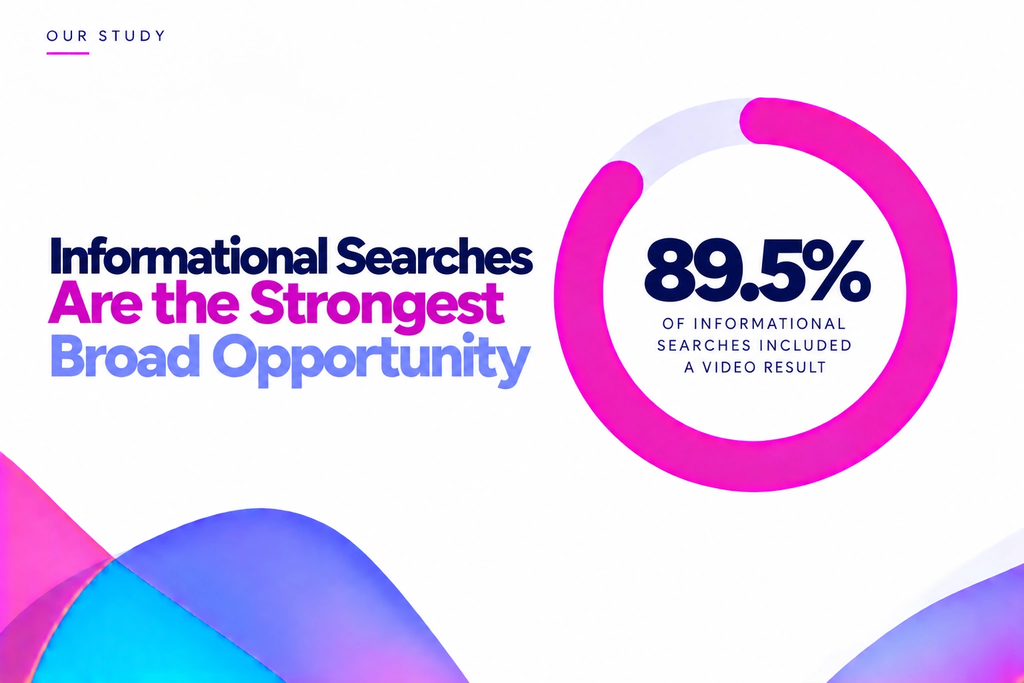
Informational searches showed the strongest opportunity for video, with video appearing in 89.5% of the searches analyzed.
This was the highest rate across all major search intent categories, indicating that Google frequently uses video to answer queries where people are looking to learn, understand, or explore a topic.
The result makes sense because informational searches frequently involve:
- Learning
- Explaining
- Demonstrating
- Troubleshooting
- Teaching
- Understanding
- Exploring
- Performing a task
However, our study also shows why informational intent should not be treated as a single, uniform category when evaluating video opportunities.
The specific language and task behind the query matter, and this becomes particularly clear when “how to” searches are compared with definition-based searches.
The 93.8% Finding: How-To Searches Are the Strongest Video Signal
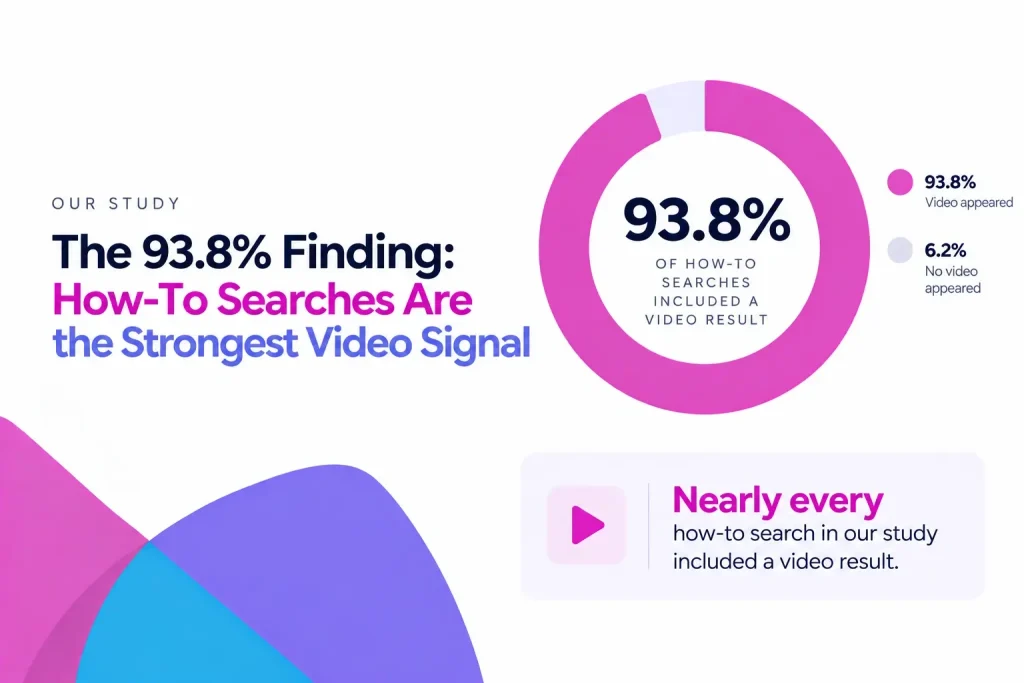
The most notable finding was the 93.8% video presence for how-to searches.
Of all the how-to queries analyzed, almost all surfaced video, making how-to searches one of the clearest signals that a keyword may be a strong opportunity for video content.
The reason is closely tied to the nature of the searcher’s task.
A how-to query is not simply asking for information; it is asking for guidance on how to complete a specific action, which creates a natural role for visual explanation and demonstration.
Consider the difference between “What is cloud computing?” and “How to troubleshoot Wi-Fi issues.” The first query may be adequately addressed with a clear written explanation, while the second is inherently procedural and can benefit from showing the user what to do, where to click, and what to expect at each stage.
This distinction is important for content planning because information retrieval does not always require video, whereas process execution often creates a stronger case for it.
Our study found this pattern across technology, DIY, automotive, education, and other categories, suggesting that the underlying task is often more useful than the topic itself when identifying video opportunities.
Definition Searches Reveal an Important Contradiction
Definition-style searches, such as “What is,” “What are,” “Meaning of,” and “Definition of,” showed video in 50.9% of cases. That is much lower than the 93.8% seen for how-to searches, even though both types are considered informational searches.
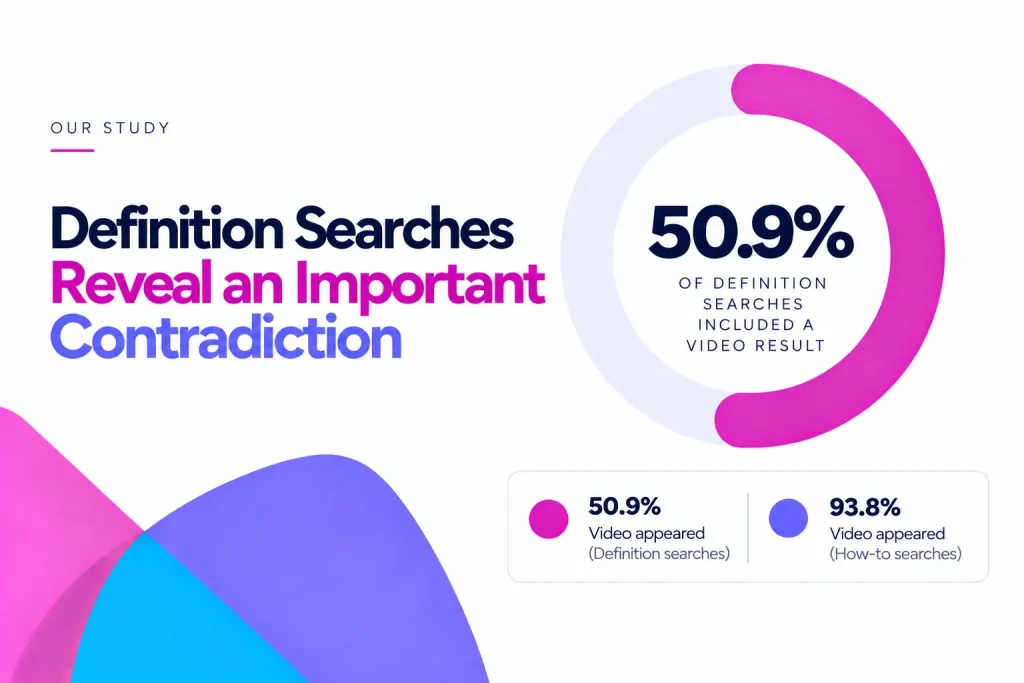
This difference is one of the more important findings in our study because it shows that broad intent categories can conceal significant differences in content-format suitability. Two keywords may both be classified as informational, yet the nature of the user’s task can create very different opportunities for video.
For marketers, this means informational intent should be treated as a starting point rather than a sufficient reason to produce video.
Labelling every informational keyword as a video opportunity risks overlooking the specific search behavior and SERP conditions that determine whether video is actually appropriate.
Search Intent Needs to Be Decomposed Into Searcher Tasks
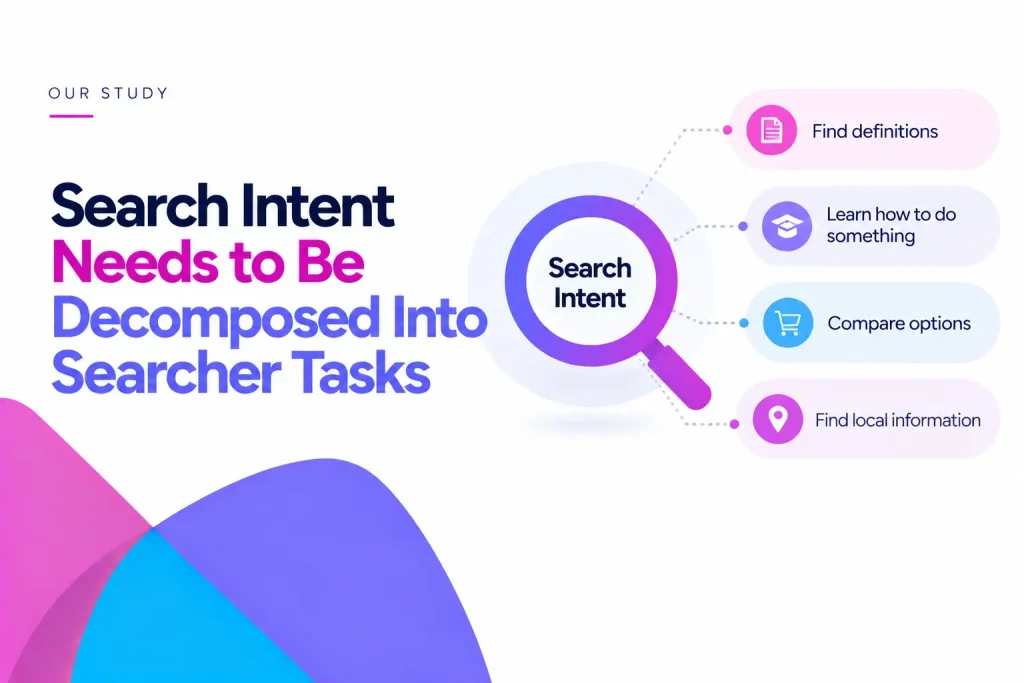
Our study suggests that marketers should look beyond traditional search-intent labels and examine the specific task behind each query.
Rather than asking only whether a keyword is informational, the more useful question is what the searcher is actually trying to accomplish and whether video helps them accomplish it.
A user looking to learn a fact may present a moderate video opportunity, while someone trying to understand a concept may benefit more from visual explanation. Queries focused on completing a process or troubleshooting a problem represent stronger opportunities because demonstration can directly support the task, while comparison queries can also benefit from video when users need to evaluate differences between options.
The opportunity changes again when the searcher is ready to purchase immediately, where video may have a more limited role depending on the product and SERP, or when the goal is simply to navigate to a specific website, where video is generally less relevant.
This task-based approach provides a more useful framework for content planning because it connects video production decisions to what the searcher actually needs from the result.
Comparison and Best Searches Are Another Major Video Opportunity
Video is present in approximately 82.3% of searches containing comparison-oriented terms such as:
- Best
- Top
- Vs
- Versus
- Compare
This represents another significant video opportunity, particularly because these searches often occur when users are evaluating products, services, or alternatives rather than simply looking for a definition or basic explanation.
The nature of the searcher’s task also makes video well suited to this type of query. At this stage, users may want to see products demonstrated, options compared, features tested, experiences reviewed, or differences explained in a way that allows them to make a more informed choice.
Our study found examples of “best” and comparison-oriented queries producing YouTube results across technology, DIY, fitness, food, automotive, and other sectors. The pattern suggests that marketers should look beyond direct product or service keywords and consider the comparison, evaluation, and review searches that users perform before reaching a purchasing decision.
Commercial Searches Are More Video-Friendly Than Many Marketers Assume
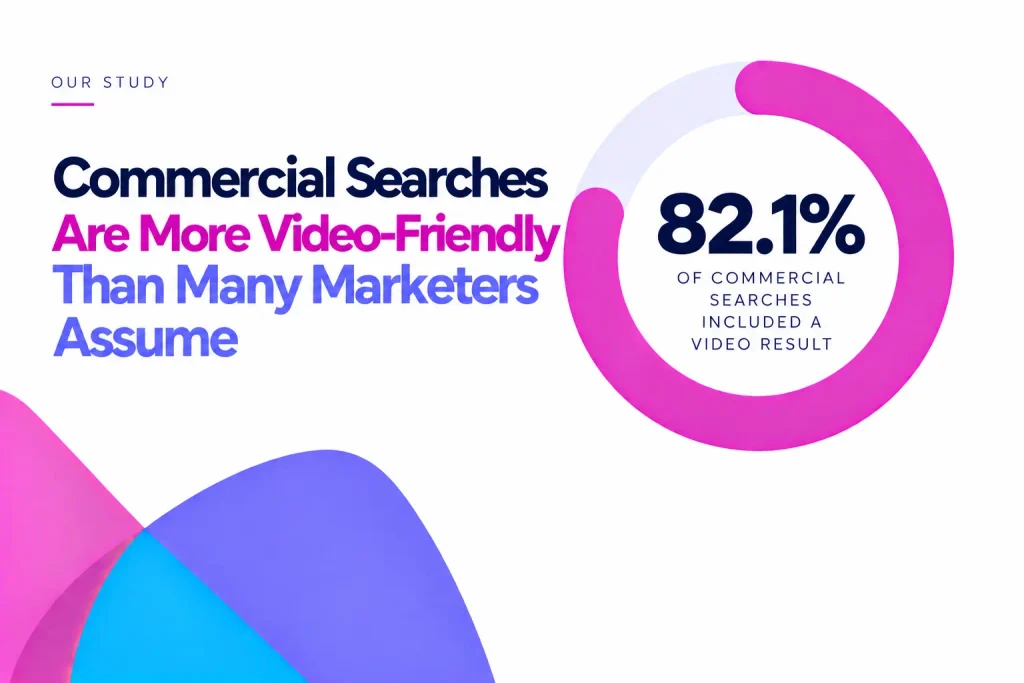
Video appeared in 82.1% of commercial searches, indicating that commercial intent can create a substantial opportunity for video alongside more traditional text-based SEO.
This is particularly relevant for searches where users are evaluating products, services, platforms, or competing options before deciding what to choose.
Commercial searches often include queries such as:
- Best products
- Best software
- Best equipment
- Best services
- Best platforms
- Best tools
- Product reviews
- Product comparisons
These searches typically involve a need for evidence, and video can provide that evidence through demonstrations, comparisons, reviews, and practical explanations that are difficult to convey through text alone.
The finding suggests that marketers should not treat commercial keywords as exclusively transactional or text-led opportunities. When the searcher’s task involves evaluating what is available and deciding which option best fits their needs, video can play a meaningful role in supporting that decision.
Transactional Searches Have the Weakest Major Video Presence
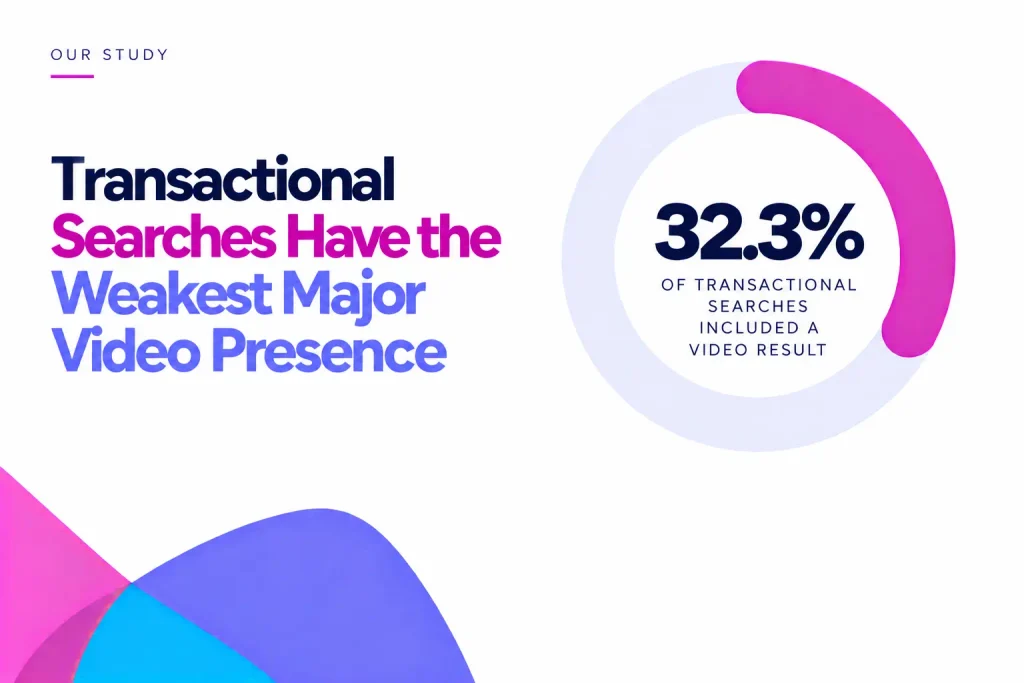
Transactional searches had the lowest video presence among the major intent categories, with video appearing in 32.3% of searches.
These queries typically indicate that the user is ready to take a specific action, such as buying, ordering, applying, registering, subscribing, hiring, or completing a purchase, so the immediate objective is often action rather than further education.
This creates a clear difference between informational and transactional searches.
- Informational searches: Video appeared in 89.5% of searches, where users are often looking for explanations, demonstrations, or guidance.
- Transactional searches: Video appeared in just 32.3% of searches, where users are more focused on completing an action, such as buying or signing up.
That is a 57.2 percentage-point difference, showing that video visibility depends heavily on what the searcher is trying to accomplish.
Queries containing shopping-oriented language such as “buy,” “purchase,” “shop,” and “for sale” produced video in approximately 31.3% of cases in our study.
This closely aligns with the broader transactional finding and reinforces the pattern that searches focused on immediate purchase or action tend to present fewer video opportunities than searches earlier in the decision process.
The finding suggests that businesses should be cautious about making a product video the primary organic video strategy for highly transactional queries such as “buy headphones online” or “buy office furniture online.”
The stronger opportunity may sit one step earlier, where users are still researching their options, comparing products, understanding features, or deciding what best meets their needs.
Navigational Searches Are Also Relatively Weak
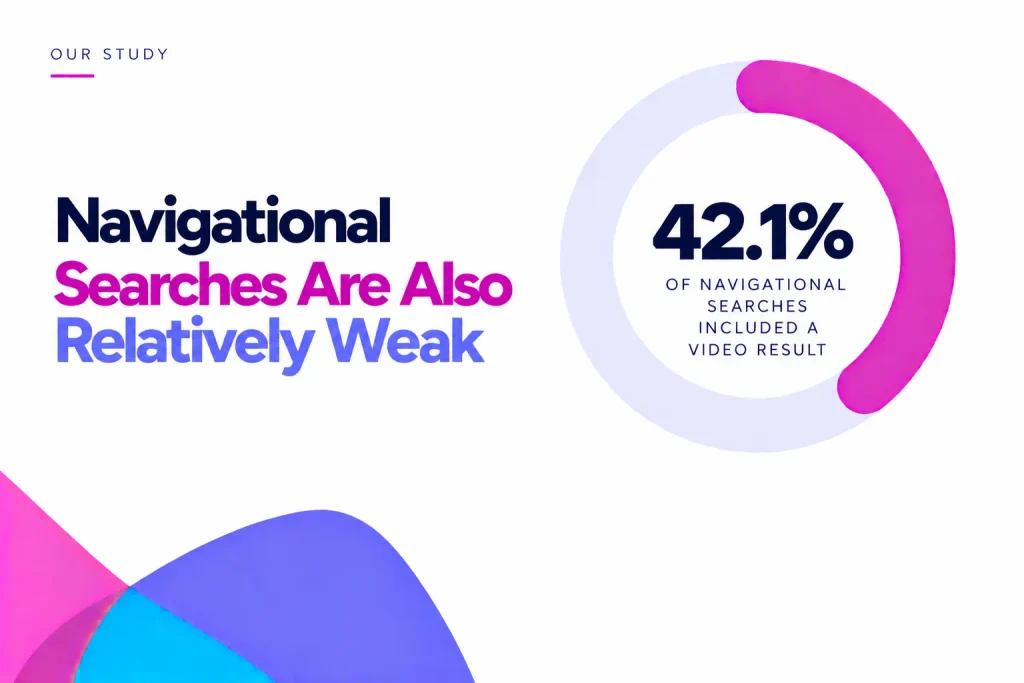
Video appeared in 42.1% of navigational searches, placing this category well below informational and commercial searches.
Navigational queries are primarily intended to take the user to a specific destination, such as a login page, official website, platform homepage, software portal, or brand destination, which means the user’s objective is usually already clearly defined.
In these situations, the searcher is generally looking for access rather than explanation, making video less relevant to the immediate task.
This helps explain why navigational searches showed substantially lower video presence than informational searches in our study, where users were more often seeking knowledge, guidance, or solutions.
A New Video Opportunity Hierarchy
The study provides a more practical way to prioritize keywords for video content by grouping them according to their observed video presence.
How-to and instructional queries represent the strongest opportunity, with video appearing in 93.8% of searches, followed by broader informational, best/comparison, and commercial queries, all of which showed video presence above 80%.
| Opportunity Level | Query Type | Video Presence |
| Very High | How-to / instructional | 93.8% |
| High | Informational | 89.5% |
| High | Best comparison | 82.3% |
| High | Commercial | 82.1% |
| Selective————————————— | Definition-oriented | 50.9% |
| Selective | Navigational | 42.1% |
| Lower | Transactional | 32.3% |
| Lower | Buy/shopping | 31.3% |
This hierarchy is more actionable than simply telling marketers that video works for informational keywords. It gives video marketing teams a framework for distinguishing between different types of searches and allocating video production resources according to the strength of the opportunity indicated by the SERP.
Industry Changes the Video Opportunity
Search intent is not the only factor influencing video visibility.
The study covers 35 industries and niches, and the proportion of searches where video appeared varies considerably across them, indicating that the opportunity for video can differ significantly depending on the market and subject area.
This means a keyword strategy cannot rely on search intent alone. The industry context also needs to be considered, particularly when determining where video production is likely to have the greatest potential to support organic search visibility.
Highest observed video presence
| Industry | Video Presence |
| Entertainment/Media | 85.3% |
| Gaming | 82.5% |
| Arts/Crafts | 80.0% |
| Music | 75.0% |
| Gardening | 75.0% |
| DIY/Home Improvement | 74.7% |
| Technology | 74.5% |
| Automotive | 72.7% |
| Home Improvement | 70.5% |
| Marketing/Business | 69.5% |
Lower observed video presence
| Industry | Video Presence |
| Restaurant/Hospitality | 50.0% |
| Real Estate | 49.0% |
| Parenting | 47.5% |
| Event Planning | 42.5% |
| Healthcare/Medical | 35.3% |
| Insurance | 35.0% |
| Law/Legal | 30.0% |
The industry results demonstrate that video opportunity is not distributed evenly across the search landscape.
Entertainment and Media Have the Strongest Video Environment
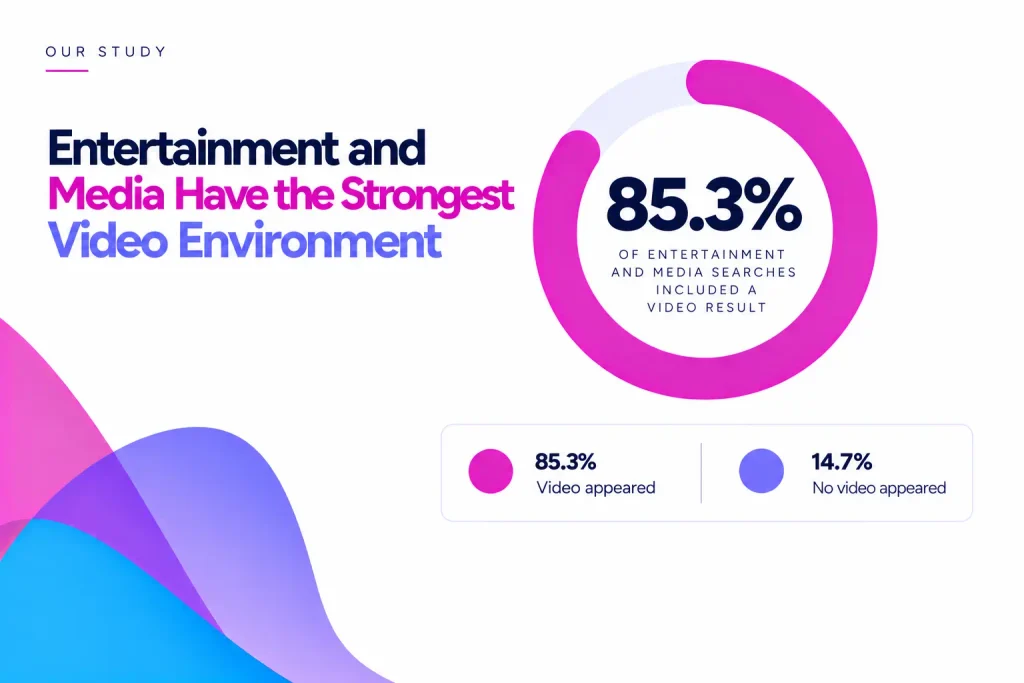
Entertainment and Media recorded an 85.3% video presence rate, the highest among the industries and niches examined.
This is consistent with the inherently visual and experiential nature of the sector, where users frequently search for content related to YouTube, podcasts, video creation, streaming, social media content, audience growth, and video editing.
It shows a particularly strong concentration of video results around instructional and practical searches within this category. More broadly, the finding suggests that industries built around visual experiences, demonstrations, or media consumption may have a structural advantage when it comes to video visibility in search.
Technology Has a Strong Video Opportunity
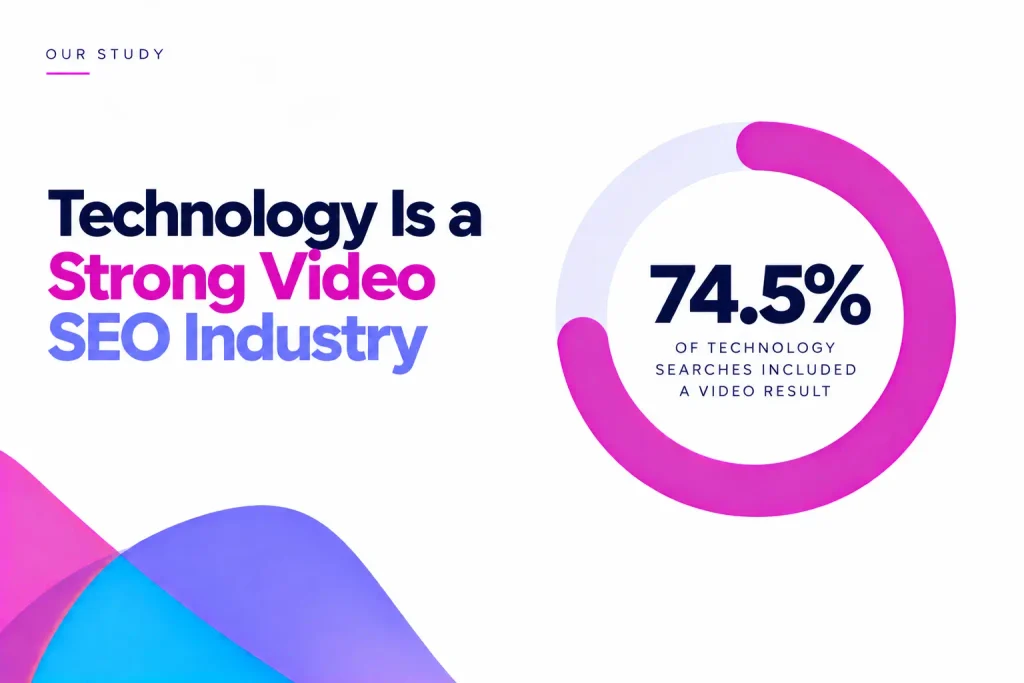
Technology recorded a 74.5% video presence rate, reflecting the wide range of technical tasks for which users seek practical guidance.
The category combines several video-friendly search behaviors, including how-to queries, troubleshooting, software tutorials, product comparisons, setup instructions, technical explanations, and demonstrations.
It includes video results for searches involving laptop troubleshooting, Windows optimization, smartphone backups, malware protection, software installation, and other technical tasks.
For technology companies, this creates a particularly relevant opportunity to use video as part of their organic search strategy, especially across educational, support, troubleshooting, and product-related content.
Healthcare Is a More Complicated Video Market
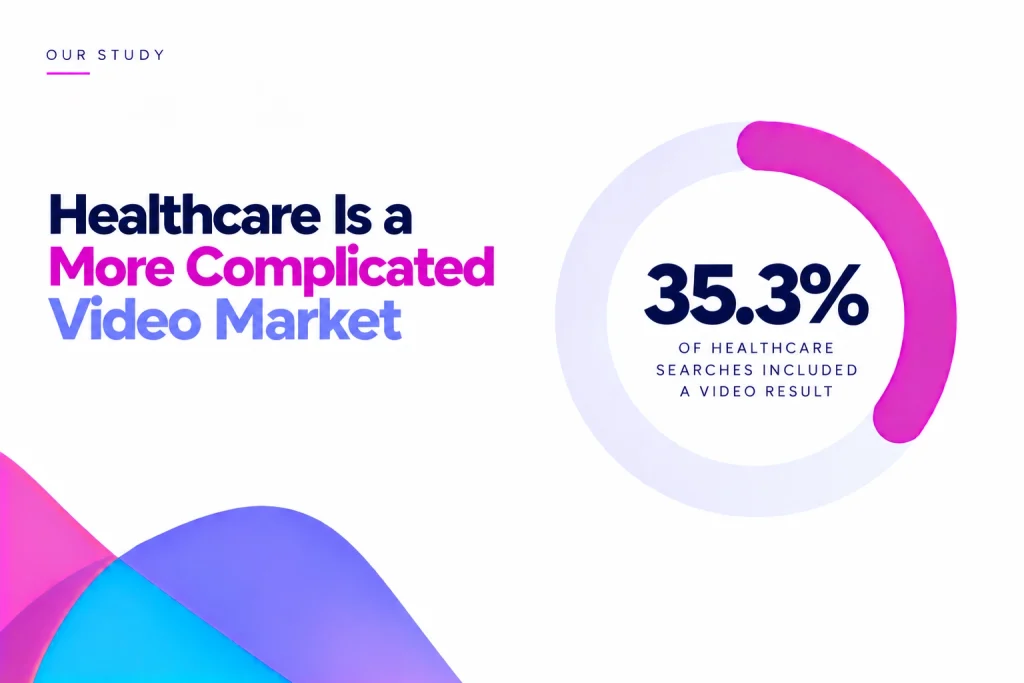
Healthcare/Medical recorded a 35.3% video presence rate, which is considerably lower than the rates observed in technology, automotive, and home improvement.
The finding is notable because healthcare contains a large number of informational searches, reinforcing the broader point that informational intent alone does not determine whether video will appear or whether it is the most appropriate format.
Healthcare also introduces additional considerations around accuracy, credibility, and the quality of information presented to users, particularly for sensitive medical topics.
The lower overall video presence should therefore not be interpreted as a reason for healthcare organizations to avoid video but rather as an indication that they should focus on topics where visual content genuinely improves understanding and where information can be provided through credible, professionally reviewed sources.
Our study illustrates both sides of this pattern, with some health-related how-to searches surfacing YouTube results while others did not.
This variation suggests that healthcare organizations should evaluate individual topics and SERPs rather than assuming that the broader industry’s video presence rate applies equally to every healthcare keyword.
Law and Insurance Show the Lowest Video Opportunity
Law/Legal had a 30.0% video presence rate, while Insurance recorded 35.0%, putting both among the industries with the lowest video visibility in the study.

This does not mean businesses in these industries should avoid video, but rather that they may need to be more selective about the topics they turn into videos.
The strongest opportunities are likely to come from searches where visual explanations add real value, such as
- Legal procedures
- Claims processes
- Client education
- Complex concepts
- Expert commentary, and
- Frequently asked questions
The variation between individual queries also shows why businesses should evaluate the SERP for each topic instead of assuming that video will perform the same way across an entire industry.
Video Is More Common When the SERP Contains Fewer Traditional Organic Results
Our study found that searches where video was present had a median organic result count of 8, compared with 10 for searches without video, and the average was also lower for video-present searches.
This relationship is statistically strong, but it should not be interpreted as evidence that adding video causes Google to reduce the number of traditional organic results.
Our study does not establish causality; a more defensible interpretation is that SERP composition varies according to the perceived needs of the query, with multimedia content becoming more prominent when Google determines that it may better satisfy the searcher’s task.
This distinction is important for understanding organic video marketing as more than a YouTube distribution strategy. It’s fundamentally about responding to the format of the SERP and the content experience Google is presenting for a particular query.
Optimal Video Length: The Median Ranking Video Is About 10 Minutes
Video duration is another notable finding from our study.
Across searches where video was present, the median duration of the top-ranking video was 601 seconds, or approximately 10 minutes, while the mean was considerably higher because a smaller number of exceptionally long videos pulled the average upward.
The median provides a more useful picture of the typical ranking video and challenges the assumption that organic search-focused videos need to be short.
Our study does not support a universal preference for short-form video in organic search, suggesting instead that duration should be determined by the complexity of the searcher’s task and the depth of explanation required.
The 10–15 Minute Range Is the Most Common
The distribution of top-ranking video durations in our study shows a broad range of formats, with the largest concentration falling between 10 and 15 minutes.
| Video Duration | Share of Video Results |
| Under 30 seconds | 2.5% |
| 30–59 seconds | 4.4% |
| 1–2 minutes | 7.2% |
| 2–5 minutes | 13.8% |
| 5–10 minutes | 21.9% |
| 10–15 minutes | 23.6% |
| 15–20 minutes | 11.0% |
| 20–30 minutes | 8.8% |
| 30–60 minutes | 4.9% |
| Over 60 minutes | 1.9% |
Videos in the 10–15 minute range accounted for 23.6% of video results, making it the largest single duration category in our study.
This is significant because it shows that organic video visibility is not dominated by extremely short clips and that longer, substantive videos can occupy prominent positions when they adequately address the searcher’s needs.
Video Length Should Follow Search Complexity
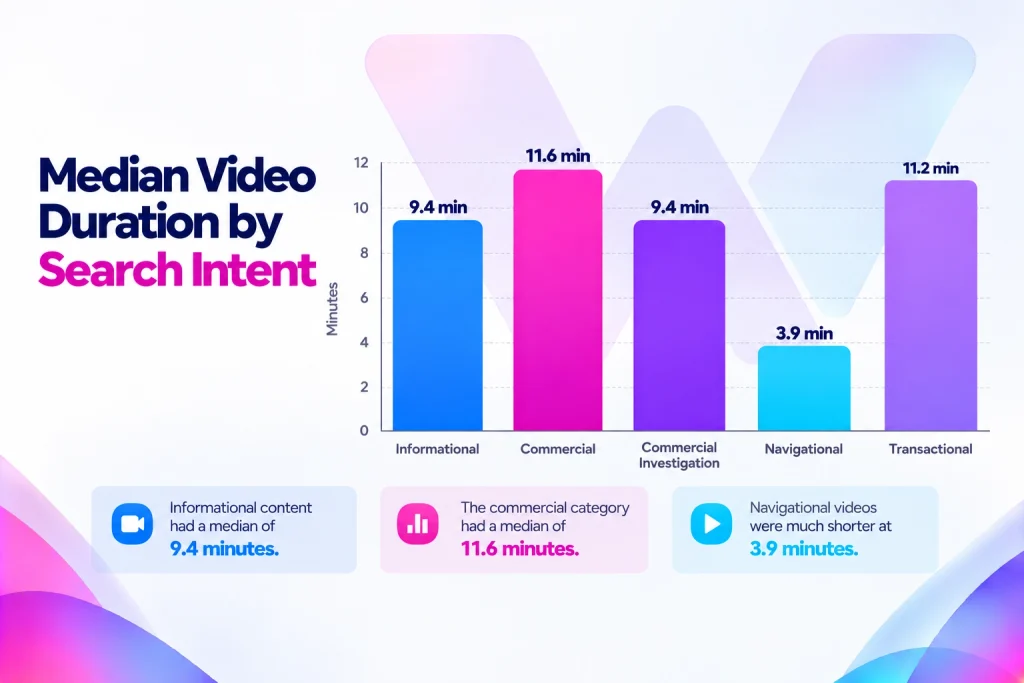
The data provides another useful insight when duration is broken down by intent.
| Search Intent | Median Video Duration |
| Informational | 9.4 minutes |
| Commercial | 11.6 minutes |
| Commercial Investigation | 9.4 minutes |
| Navigational | 3.9 minutes |
| Transactional | 11.2 minutes |
There Is No Universal Perfect SEO Video Length
The research does not support a single universal duration target.
A better principle is to match video length and depth to the complexity of the user’s task, producing a concise video for simple tasks, enough explanation and demonstration to solve moderate tasks, and as much time as necessary to provide a complete answer for complex tasks.
This is particularly important for businesses that may otherwise impose arbitrary production requirements, such as every video must be under five minutes.
The data suggests that such a rule could be counterproductive.
YouTube Dominates the Google Video Landscape
The strongest platform finding is clear: YouTube accounted for approximately 94.0% of top-ranking video hosts among searches where video was present.
Other platforms were significantly less common, with Facebook and Instagram each accounting for 2.4%, TikTok 0.5%, and individual shares for other platforms remaining below 1%.
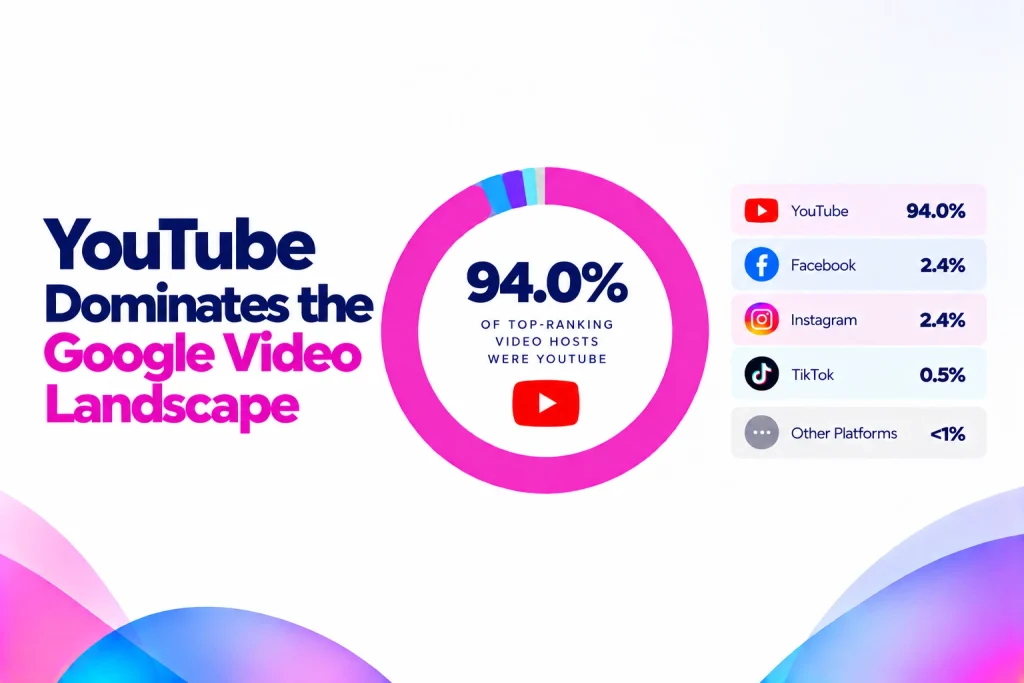
This creates a clear platform hierarchy for businesses focused specifically on Google video visibility.
While the results do not suggest that other platforms lack value, the scale of YouTube’s presence indicates that it should be central to any strategy designed to earn video visibility in Google search.
What the Study Means for Businesses
B2B Companies
B2B brands can use video to help buyers understand products, evaluate solutions, and solve technical problems. Strong formats include product demonstrations, technical tutorials, software walkthroughs, implementation guides, troubleshooting content, comparisons, and case studies.
SaaS Companies
SaaS brands have strong opportunities around practical search questions, such as how to use, configure, integrate, automate, or troubleshoot software. Search-led tutorials and demonstrations can attract users who are actively trying to solve a problem, rather than relying solely on promotional videos.
E-commerce Brands
The findings suggest that e-commerce brands should not create videos for every product or purchase keyword. Stronger opportunities may exist around best-of searches, product comparisons, reviews, buying guides, product demonstrations, and setup or usage tutorials.
Service Businesses
Service businesses should focus on the questions customers ask before they are ready to hire or buy. Topics such as processes, FAQs, explanations, what to expect, and how-to guidance can provide stronger video opportunities than purely transactional searches.
Publishers and Media Companies
Publishers can use video for explainers, tutorials, interviews, reviews, comparisons, visual guides, and expert commentary. However, not every article needs a video. SERP analysis should determine where visual content genuinely adds value.
Final Thoughts on When to Create Video Content
The findings make one thing clear: video opportunity depends more on search intent than on keyword value alone.
Video appeared in 61.7% of the 2,200+ searches analyzed, but visibility was much higher for how-to, informational, commercial, and comparison-focused searches than for transactional and shopping queries.
The research also challenges the idea that videos created for search engines need to be short. The median ranking video was around 10 minutes, with 10–15 minutes being the most common range, showing that the right length is ultimately the length needed to answer the searcher’s question properly.
YouTube was also the clear leader, appearing as the top video-hosting platform in approximately 94% of searches where video was present. This makes YouTube an important part of any search-focused video strategy, while other platforms can support wider distribution and reach.
Ultimately, the decision to create a video should start with the searcher, not the keyword. If seeing the answer makes it easier to learn, compare, understand, or complete a task, video is worth considering.

