

Explore the latest video marketing research, trends, statistics, and insights shaping video strategy, production, AI, B2B marketing, and ROI in 2026-2027.
Video marketing is no longer an emerging channel that businesses are experimenting with. It has become a standard part of the marketing mix, with companies using video across awareness, education, product marketing, customer acquisition, sales enablement, and retention.
The more interesting question is therefore not whether businesses should be producing video. It is how they can produce useful video consistently, distribute it effectively, and generate more commercial value from every piece of content they create.
This report examines the latest research on video adoption, consumption, formats, distribution, B2B marketing, production costs, artificial intelligence, and measurement to understand where the industry is heading.
Table of Contents
Key Takeaway
- 91% of businesses use video, making adoption itself less of a competitive advantage.
- The opportunity is shifting from producing more videos to deciding which topics, formats, platforms, and audiences deserve video investment.
- WayaFrame’s analysis of more than 2,200 Google searches found video in 61.7% of searches, rising to 93.8% for how-to queries.
- WayaFrame’s study of more than 1,500 SaaS companies found that 32.3% used homepage video, but only 3.7% featured a homepage product demo.
- 48.6% of marketers ranked short-form video among their top three media formats for ROI, although long-form remains valuable for education, demonstrations, and B2B content.
- WayaFrame’s analysis of 3,012 TikTok videos found that smaller creators can generate substantially more reach relative to their follower base, while larger creators tend to achieve more consistent absolute reach.
- AI is increasingly being used for scripting, editing, repurposing, translation, dubbing, social clips, and other production tasks.
- Repurposing long-form content into short clips, social posts, website content, sales assets, and localized versions is becoming increasingly important as production demands grow.
- Short-form works well for discovery and engagement, while longer videos remain valuable when the audience needs depth, demonstration, or detailed explanation.
- The competitive advantage is moving from simply creating more videos to creating the right video, distributing it effectively, and extracting more measurable value from every production.
Video Marketing Has Reached Mass Adoption
The strongest starting point is the sheer level of adoption.
Ninety-one percent of businesses use video as a marketing tool, matching the highest level recorded in its 12-year research series. The study also found that 93% of respondents consider video an important part of their marketing strategy.
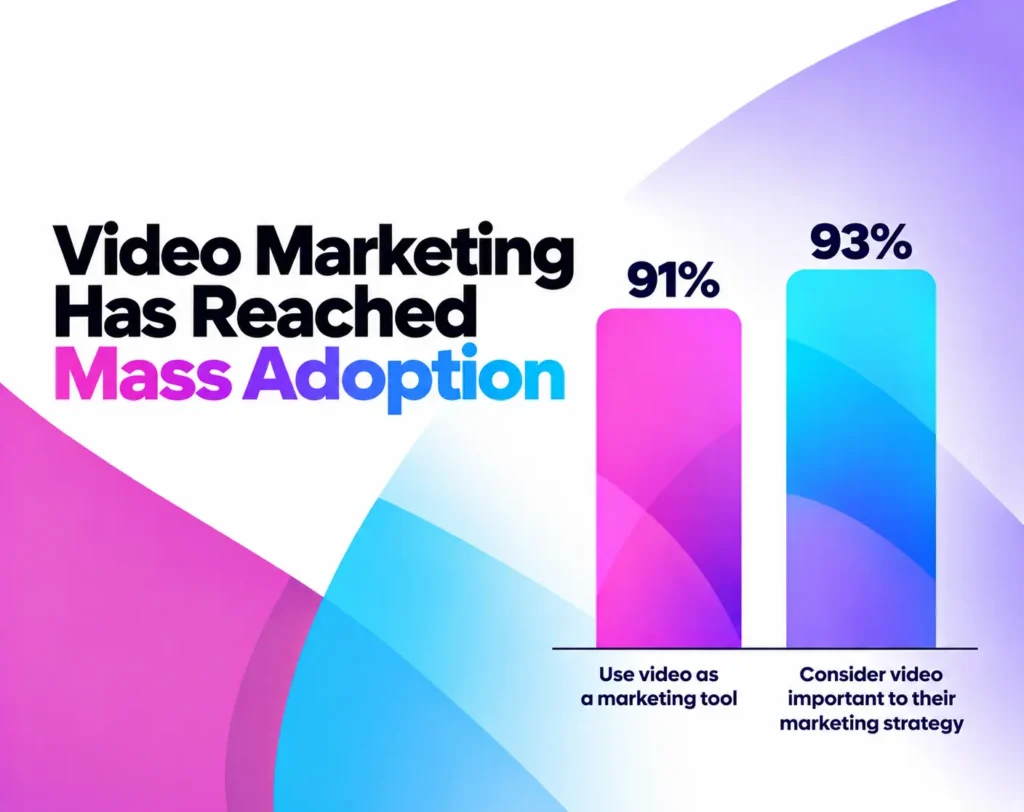
That puts video firmly in the mainstream. Once more than nine out of ten businesses are using a format, simply having a video strategy is no longer particularly distinctive.
The competitive question shifts towards execution. Businesses need to consider whether their videos answer meaningful customer questions, communicate expertise, support the buying journey, and work across the channels where their audiences actually spend time.
Video adoption
| Year | Businesses using video |
| 2025 | 89% |
| 2026 | 91% |
The two-point increase is relatively modest, but the more important figure is the 91% adoption rate itself.
Search Intent Determines When Video Content Has the Strongest SEO Opportunity
While video adoption continues to grow across industries, the decision of when to create video content remains a strategic challenge for marketers. Not every keyword, topic, or customer question creates an equal opportunity for video visibility.
To better understand where video has the strongest potential in search, WayaFrame analyzed more than 2,200 Google searches across different industries, search intents, keyword types, and SERP conditions. The study examined whether Google was more likely to surface video results depending on what users were trying to accomplish.
The findings show that video opportunity is strongly connected to searcher intent, rather than keyword popularity alone.
Video appeared in 61.7% of the searches analyzed, meaning that roughly three out of every five searches included at least one video result. However, the likelihood of video appearing varied significantly depending on the type of query.
The strongest opportunities were found in searches where users needed:
- Instructions
- Demonstrations
- Explanations
- Comparisons
- Product evaluations
- Problem-solving guidance
This suggests that video performs best when it provides something that text alone cannot easily communicate.
For marketers, the implication is clear: video planning should begin with understanding the searcher’s task, not simply identifying keywords with high search volume.
How-To Searches Are the Strongest Signal for Video Visibility in Search
Over 1500 query types were analyzed; how-to searches produced the strongest video opportunity.
WayaFrame’s research found that video appeared in 93.8% of how-to searches, making instructional queries the strongest signal for video visibility in Google Search.
The reason is closely tied to the nature of the searcher’s goal. A how-to query is not simply asking for information. It usually represents a user attempting to complete a specific action and looking for guidance along the way.
Examples include:
- How to configure software
- How to repair a device
- How to complete a process
- How to use a product
- How to solve a technical problem
These searches naturally benefit from visual explanation because users often want to see the steps involved, understand the process, and observe the expected outcome.
The finding also explains why certain industries, including technology, DIY, automotive, and education, consistently show stronger video opportunities. These categories frequently involve tasks where demonstration improves understanding.
For marketers, how-to queries represent some of the clearest opportunities to invest in video because the format directly matches the user’s objective.
Why Brands Should Evaluate Video Partnerships Beyond Follower Count
WayaFrame’s TikTok research challenges one of influencer marketing’s most common assumptions: that follower count alone determines creator value.
The study shows that audience size is only one factor.
A creator with a smaller audience may generate significant reach relative to their following if their content performs strongly with TikTok’s recommendation system.
At the same time, larger creators provide advantages through established audiences and more predictable reach.
For brands evaluating creator partnerships, stronger evaluation criteria include:
- Average views per video
- Audience relevance
- Engagement quality
- Content consistency
- Historical performance
- Ability to communicate the brand message naturally
The research suggests that creator selection should move beyond vanity metrics and focus on the relationship between audience size, content performance, and campaign objectives.
In an increasingly competitive video environment, the most valuable creator is not always the one with the largest following. It is the creator whose content can effectively reach and influence the right audience.
Short-Form Video Is Leading Reported ROI
Short-form video has become one of the most important formats in modern marketing, particularly on social platforms.
Nearly forty-nine percent (48.6%) of marketers ranked short-form video among their top three media formats for ROI. Long-form video followed at 28.6%, while live video was selected by 25.1% and user-generated content by 24%.
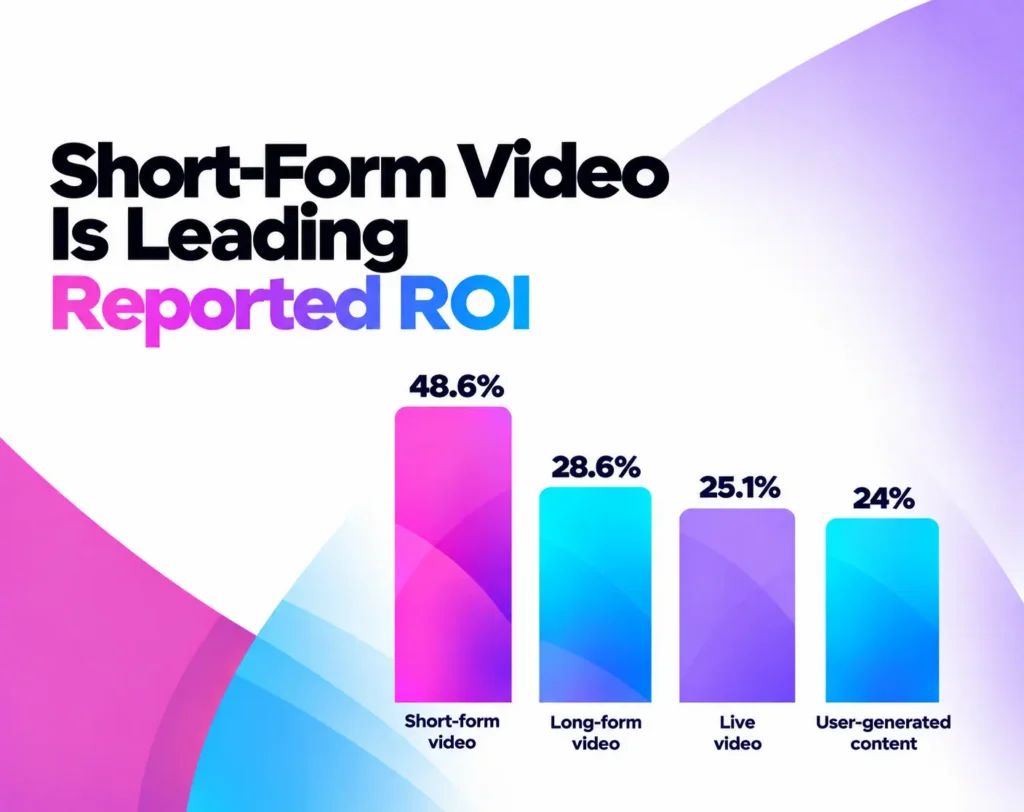
These figures should be interpreted carefully. They represent marketers’ reported assessment of ROI, not a universal measurement of how much revenue each video format produces.
Even with that qualification, the difference is substantial enough to demonstrate where marketing teams currently see the strongest return. Short-form video also fits naturally into a broader content-repurposing strategy. A webinar, product demonstration, interview, or presentation can generate multiple shorter clips rather than being published only in its original format.
This is one area where platforms such as WayaFrame reflect the direction of the industry.
Its workflow includes AI-assisted social clip creation and long-form-to-short-form conversion, allowing teams to turn longer source material into platform-specific assets without rebuilding the content from scratch.
Short-Form Video Is Part of a Larger Consumption Shift
The rise of short-form video should not be viewed in isolation from broader changes in digital consumption.
The global mobile network traffic exceeded 220 exabytes per month in Q2 2026, representing 23% year-over-year growth. The company also reported that video accounted for approximately 75% of mobile data traffic at the end of 2025.
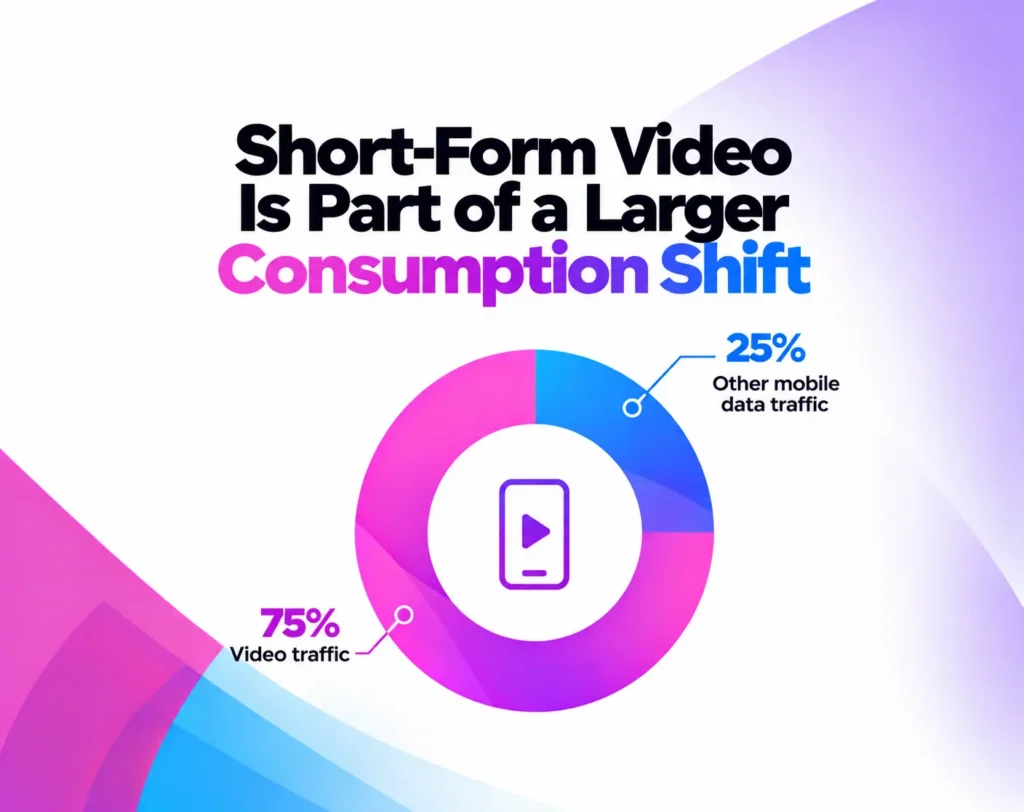
The implications for marketers are straightforward. Video is competing for attention within an environment where audiences are already consuming enormous quantities of visual content through smartphones and social platforms.
The research also highlights the importance of social video within mobile consumption, with social-platform video accounting for a substantial share of mobile video traffic in the networks it studied.
This makes the first few seconds of a video increasingly important, but it does not mean every video should be reduced to a few seconds. The appropriate length still depends on what the audience needs from the content.
More Video Is Being Produced Without Proportionate Budget Growth
The industry’s production challenge is becoming more apparent as companies increase their reliance on video.
A study of more than 13 million videos and 79 million hours of viewing data, alongside survey responses from more than 900 professionals, found that companies are continuing to produce more video, while planned budget increases have moderated.
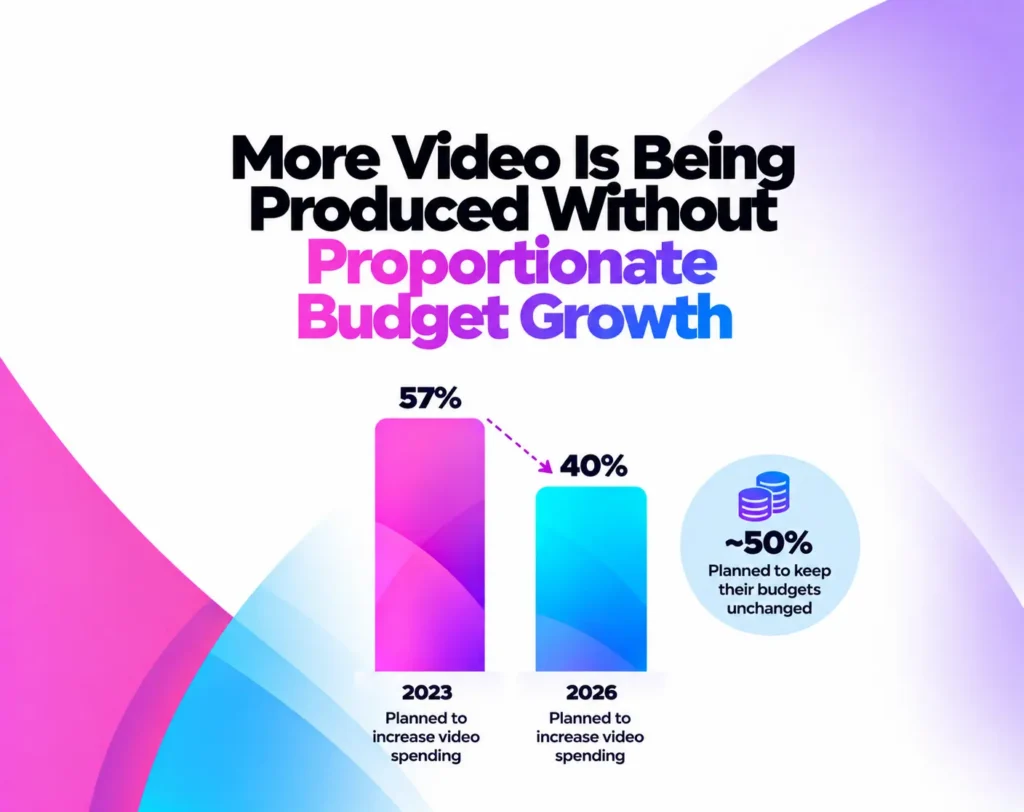
Around 40% of teams planned to increase video spending in 2026, compared with 57% in 2023. Almost half planned to keep their budgets unchanged.
This creates a practical problem for marketing teams. More channels require more creative assets, but simply increasing production headcount or outsourcing every new asset is not necessarily sustainable.
That is helping push video production towards more efficient workflows built around reusable assets, AI-assisted editing, automated repurposing, localization, and stronger pre-production.
AI Is Changing the Production Workflow
Artificial intelligence is increasingly being applied to practical production problems rather than being treated solely as a tool for generating finished videos.
Marketing teams are using AI across different stages of production, including:
- Script development
- Storyboarding
- Editing
- Transcription
- Caption generation
- Voice processing
- Translation
- Dubbing
- Social clip creation
- Video enhancement
- Content repurposing
Eighty percent (80%) of marketers use AI for content creation, and 75% use it for media production.
WayaFrame provides a useful example of how these capabilities are being consolidated into a single production environment. Its current workflow combines recording, editing, AI generation, voice tools, dubbing, subtitle translation, social clipping, enhancement, and collaboration rather than treating each task as a separate production process.
The significance is less about replacing the editor or creative director. The more immediate benefit is reducing repetitive work so that experienced people can spend more time on the parts of production that require judgment, such as story, pacing, creative direction, brand consistency, and audience relevance.
That distinction will matter as AI-generated content becomes easier to produce. When production becomes cheaper, the value of a strong idea and useful information does not disappear.
B2B Marketers Are Putting More Weight Behind Video
Video has also become an important part of B2B marketing, where the buying process often involves complex products, multiple stakeholders, and lengthy evaluation periods.
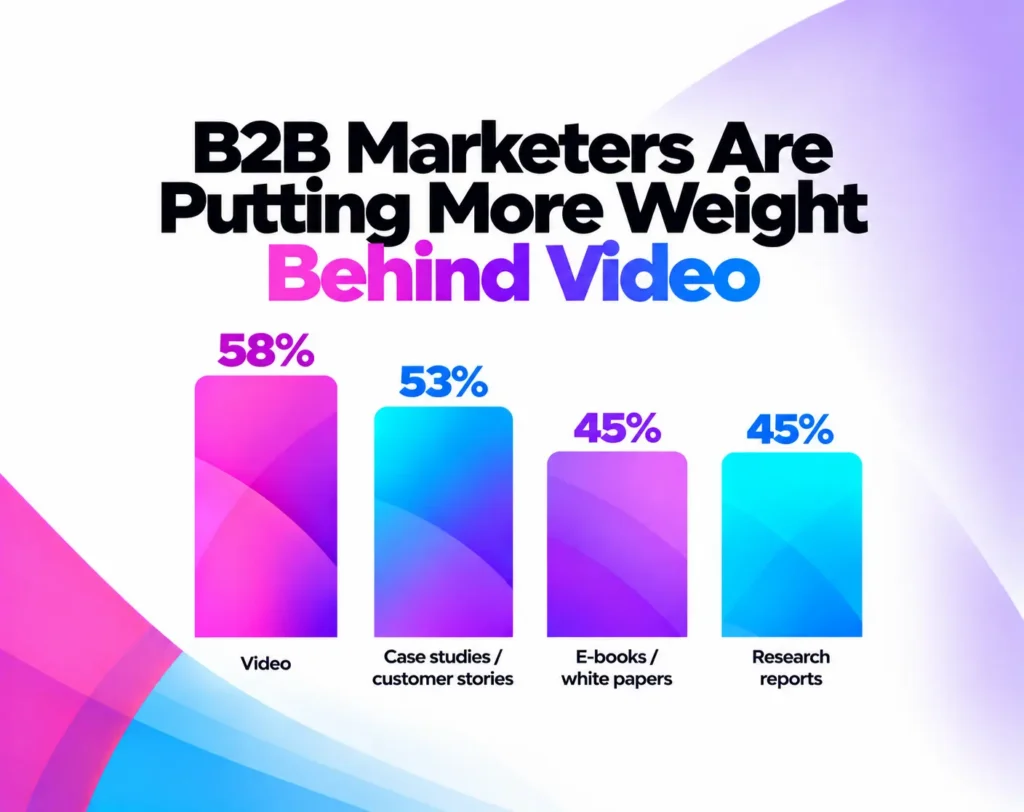
A B2B content marketing study found that 58% of B2B marketers rated video as the most effective content type for producing results during the previous 12 months. Case studies and customer stories followed at 53%, while e-books/white papers and research reports were each at 45%.
Video has an advantage in this environment because it can demonstrate a product, explain a technical concept, introduce an expert, show evidence, and address objections without relying entirely on written content.
For technology and professional services companies in particular, that makes video useful well beyond brand awareness. A technical demonstration can support consideration, while an expert interview can strengthen credibility, and a customer story can provide evidence closer to the point of purchase.
B2B Video Is Moving Through More of the Customer Journey
A 2025 B2B marketing study provides another sign of this shift.
Among the B2B marketers surveyed for the video analysis, the main goals were building brand awareness at 35%, strengthening trust and credibility at 29%, and driving conversions or sales at 23%. The study included 1,462 B2B marketers.
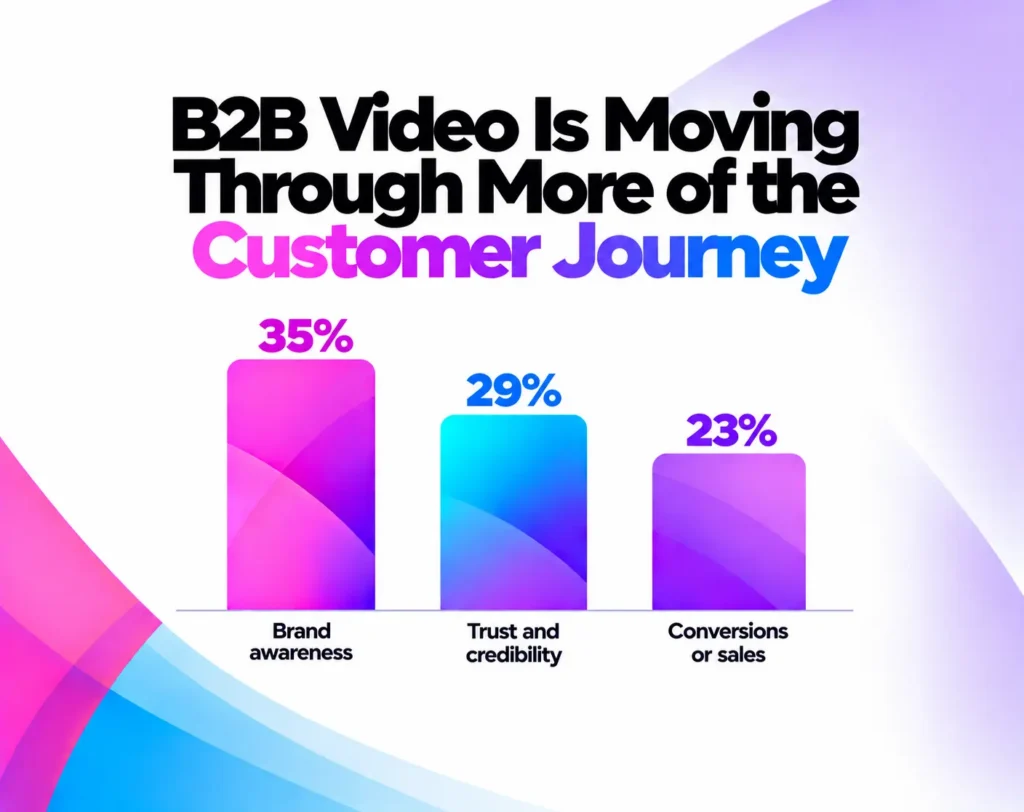
The distribution is important because it shows that video is not being confined to the top of the funnel.
B2B teams are using it across several stages:
- Awareness: Introducing the company or category.
- Education: Explaining complex topics.
- Trust: Featuring experts, customers, and evidence.
- Consideration: Demonstrating products and capabilities.
- Conversion: Addressing objections and showing how a solution works.
- Retention: Supporting customers after purchase.
This broader role also changes how video should be measured. A video that does not generate an immediate lead may still influence a later conversion or help move a prospect through a complex buying process.
YouTube Remains a Major Video Platform
The growth of short-form social video has not removed the importance of YouTube.
The rise of short-form videos on social media hasn’t made YouTube any less important. In fact, YouTube is still one of the main places people go to watch video content.
Recent digital audience research estimated that YouTube could reach at least 2.53 billion users each month through its advertising tools across the countries where audience data was available.
Recent research found that YouTube was also the most commonly used platform among video marketers, with 82% saying they use it.
This highlights an important point: the type of video you create and the platform you share it on are two different things.
Short-form video can be highly effective without making every marketing video a short-form social post. YouTube, for example, remains well suited to tutorials, product demonstrations, technical explainers, interviews, webinars, and other content where the viewer has a reason to spend more time with the subject.
Video Length Should Follow the Purpose of the Content
There is a persistent tendency in marketing discussions to search for a single ideal video length. The available evidence does not support that approach.
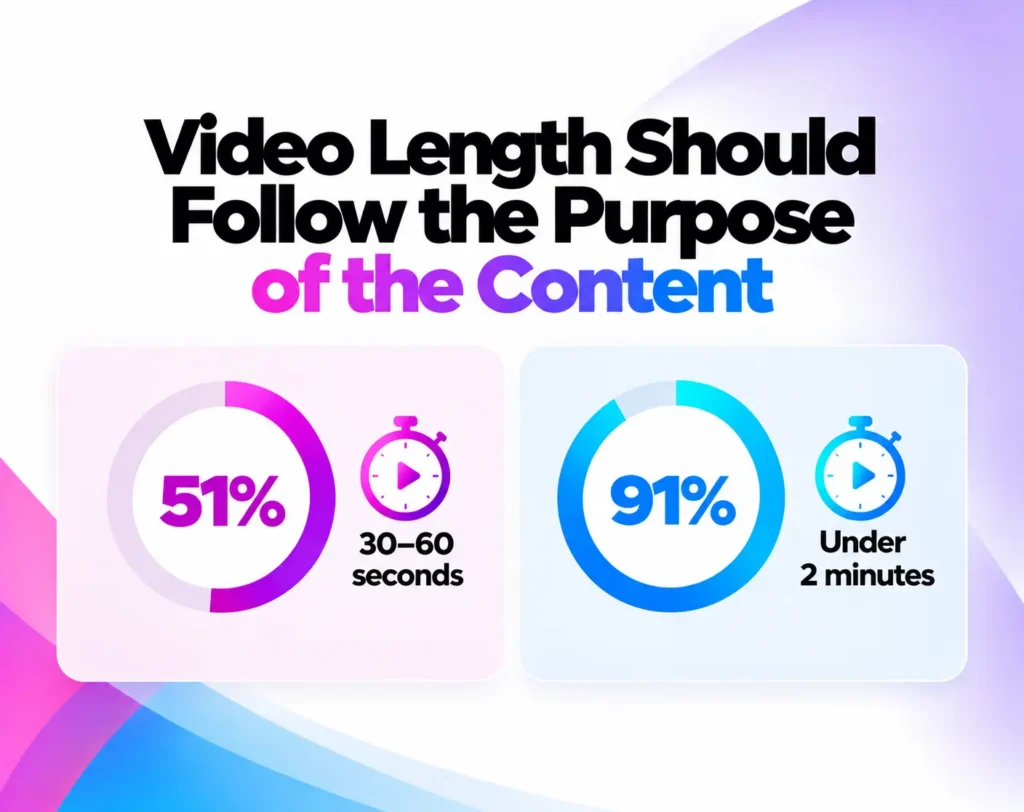
Fifty-one percent of respondents considered 30–60 seconds the optimal video length, while ninety-one percent believed effective videos should be under two minutes.
That is useful for short-form marketing, but it should not be interpreted as a universal rule.
A 20-second product teaser has a completely different job from a 12-minute software demonstration or a 45-minute technical webinar. Research also suggests that longer videos can still be effective when the topic is detailed enough to keep viewers interested and the extra time adds real value.
The better question is therefore not “How short can this video be?” but “How much information does the audience need to accomplish what this video is supposed to do?”
Video Measurement Is Moving Beyond Views
Views remain one of the most commonly tracked video metrics, but they are becoming less useful as a standalone measure of performance.
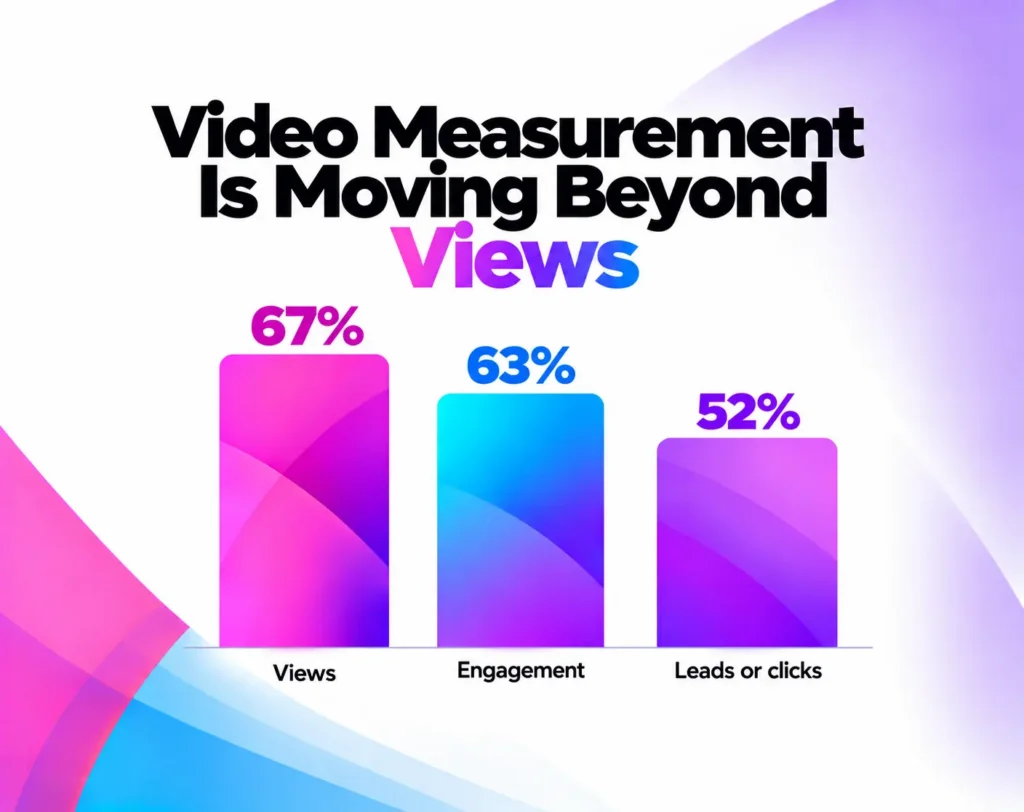
An industry study reports that 67% of video marketers identify views as a top KPI, followed by engagement at 63% and leads or clicks at 52%.
For marketers focused on commercial outcomes, the measurement framework needs to go further.
Useful metrics can include:
- Video views
- Average watch time
- Completion rate
- Engagement rate
- Click-through rate
- Website sessions
- Lead generation
- Assisted conversions
- Sales pipeline influenced
- Revenue attributed or assisted
The right metric depends on the video’s role. A brand-awareness video and a product-demo video should not necessarily be judged against the same KPI.
This is particularly important for B2B marketing, where a video may influence several people involved in a buying process before a conversion is recorded.
One Video Is Increasingly Becoming Multiple Assets
The economics of video change considerably when a single production can serve several purposes.
A 30-minute interview, for example, can become:
- The original YouTube video
- Five short social clips
- An expert quote graphic
- A blog article
- A customer email
- A sales enablement asset
- A website embed
- A podcast episode
- Short-form educational clips
This is one reason repurposing has become an important part of modern video production.
Companies commonly repurpose video content into social clips, with many using those clips to drive traffic back to their websites.
WayaFrame’s production workflow is aligned with this model, offering tools for turning longer videos into shorter social assets, changing aspect ratios, adding captions, and translating or dubbing content for other audiences.
For marketing teams, the advantage is straightforward: the value of a production is no longer limited to the original video.
Localization Is Becoming More Practical
International businesses have traditionally faced a difficult choice when adapting video for different markets. They could produce separate versions from scratch or accept that one piece of content would not work equally well across languages and markets.
AI-assisted dubbing, subtitle translation, voice processing, and automated resizing are reducing some of that production friction.
WayaFrame, for example, combines AI video dubbing, subtitle translation, voice-related tools, and aspect-ratio adaptation within its workflow.
The technology does not remove the need for human review. Language, cultural context, pronunciation, terminology, and brand tone still require oversight, particularly for technical or regulated industries.
It does, however, make it more practical to consider localization earlier in the content strategy rather than treating every international version as an entirely new production project.
The Real Challenge Is Becoming Video Efficient
The report reveals a tension that is easy to overlook.
Businesses are producing more video, audiences are consuming more video, and marketers are increasingly dependent on the format. At the same time, video teams are facing pressure to control production costs and deliver content across an expanding number of channels.
This changes the economics of video production.
The question is no longer simply whether a company can afford to produce a video. It is whether the production process can create enough downstream value to justify the investment.
That value can come from:
- Reusing footage across channels
- Turning long-form content into short-form clips
- Automating repetitive editing tasks
- Creating multiple aspect ratios from one production
- Translating content into additional languages
- Building reusable brand templates
- Creating content from existing documents and presentations
- Using AI to accelerate pre-production
- Connecting video performance to business outcomes
This is where AI-assisted platforms such as WayaFrame become relevant to the broader market trend. Its current product workflow is designed around creating, editing, enhancing, localizing, repurposing, and collaborating on video within the same production environment.
The Competitive Advantage Is Moving Upstream
When almost every serious marketing team is producing video, the video itself is no longer the scarce resource.
The scarce resources are attention, expertise, original ideas, credible information, strong creative direction, and the ability to turn those inputs into content efficiently.
That puts greater importance on the work that happens before production begins.
A strong video strategy starts with questions such as:
- What does the audience actually need to know?
- What problem is the video solving?
- Why should someone watch this instead of another video?
- What evidence or expertise can the company contribute?
- Where will the video be distributed?
- What other assets can be created from the production?
- What business outcome should it influence?
The technology can make production faster, but it cannot answer those questions automatically.
What the Data Says About the Future of Video Marketing
The report does not point to one winning format or platform. Instead, it shows an industry becoming more sophisticated in how it thinks about video.
Several patterns are particularly clear.
- Video is now foundational: With 91% of surveyed businesses using video, the medium has moved beyond early adoption.
- Short-form is important, but not universal: Short-form video currently leads reported ROI, but long-form content continues to serve important educational, search, B2B, and product-marketing roles.
- B2B video has matured: Video is now being used for trust, education, product consideration, and conversion, rather than being limited to awareness campaigns.
- Production efficiency matters more: As content requirements grow without equivalent budget increases, teams need ways to produce more useful assets from each production.
- AI is becoming infrastructure: AI is increasingly being embedded across the production workflow, from scripts and storyboards through editing, localization, and repurposing.
- Distribution matters as much as creation: A good video placed in the wrong environment can underperform, while a well-adapted asset can work across several channels.
What the Report Means for Marketing Teams
For companies building or revising their video strategy, the evidence supports several practical priorities.
Build around content pillars rather than individual videos
Instead of planning every video independently, identify recurring subjects that can generate a series of related assets.
Create one strong source asset and repurpose it
A webinar, interview, product demonstration, or research presentation can become the foundation for multiple pieces of content.
Match format to intent
Use short-form content when the objective is rapid discovery or social engagement. Use longer formats when the audience needs explanation, evidence, demonstration, or depth.
Treat AI as a production layer
Use AI where it removes repetitive work, but keep humans responsible for creative direction, accuracy, messaging, and final editorial decisions.
Build for multiple channels from the start
Consider aspect ratios, captions, clips, thumbnails, translations, and distribution requirements before production begins.
Measure according to the video’s job
Do not judge an awareness video using the same criteria as a product demonstration or conversion asset.
Final Thought on State of Video Marketing
Video marketing has entered a more mature phase.
The evidence no longer supports treating video as a novel format that businesses should simply “start using.” With adoption above 90%, the market has moved into a period where the quality of strategy, creative execution, distribution, measurement, and production efficiency matters considerably more than adoption itself.
Short-form video is currently generating the strongest reported ROI among the formats measured in recent marketing research, while long-form video continues to play an important role in education, product marketing, B2B communication, and search-driven content.
At the same time, the production environment is changing. AI-assisted tools are making it easier to edit, repurpose, translate, enhance, and distribute video, while businesses are being asked to create more content without necessarily receiving proportionally larger budgets.
The most important shift may therefore be from video production to video systems.
The strongest teams are unlikely to think of each video as a standalone asset. They will increasingly treat a video production as a source from which multiple pieces of useful, platform-specific, measurable content can be created.
That is where the next competitive advantage in video marketing is likely to be found: not simply in producing more videos, but in getting more value from every idea, every production, and every minute of audience attention.
Sources
- Wyzowl, Video Marketing Statistics 2026
- Wistia, State of Video Report 2026
- HubSpot, State of Marketing 2026
- Content Marketing Institute, B2B Content Marketing Benchmarks, Budgets, and Trends 2025
- LinkedIn/Ipsos, 2025 B2B Marketing Benchmark
- Ericsson, Mobility Report and Mobile Traffic Data 2026
- DataReportal, Digital 2025 Global Overview Report

