Skip to content

Last updated on April 21, 2026

Removing Green Screen Backgrounds

Chroma key (green screen) is a real-time color-based filter that makes a specific color in your clip transparent. It works on both video and image clips and updates instantly as you adjust settings, so you can see the result live on the canvas.

This is ideal for studio footage shot against a green or blue screen, but it works with any solid-color background.

For AI-powered background removal that works with any background (not just solid colors), see How to Remove Video Backgrounds with AI.

Green Screen

How to access

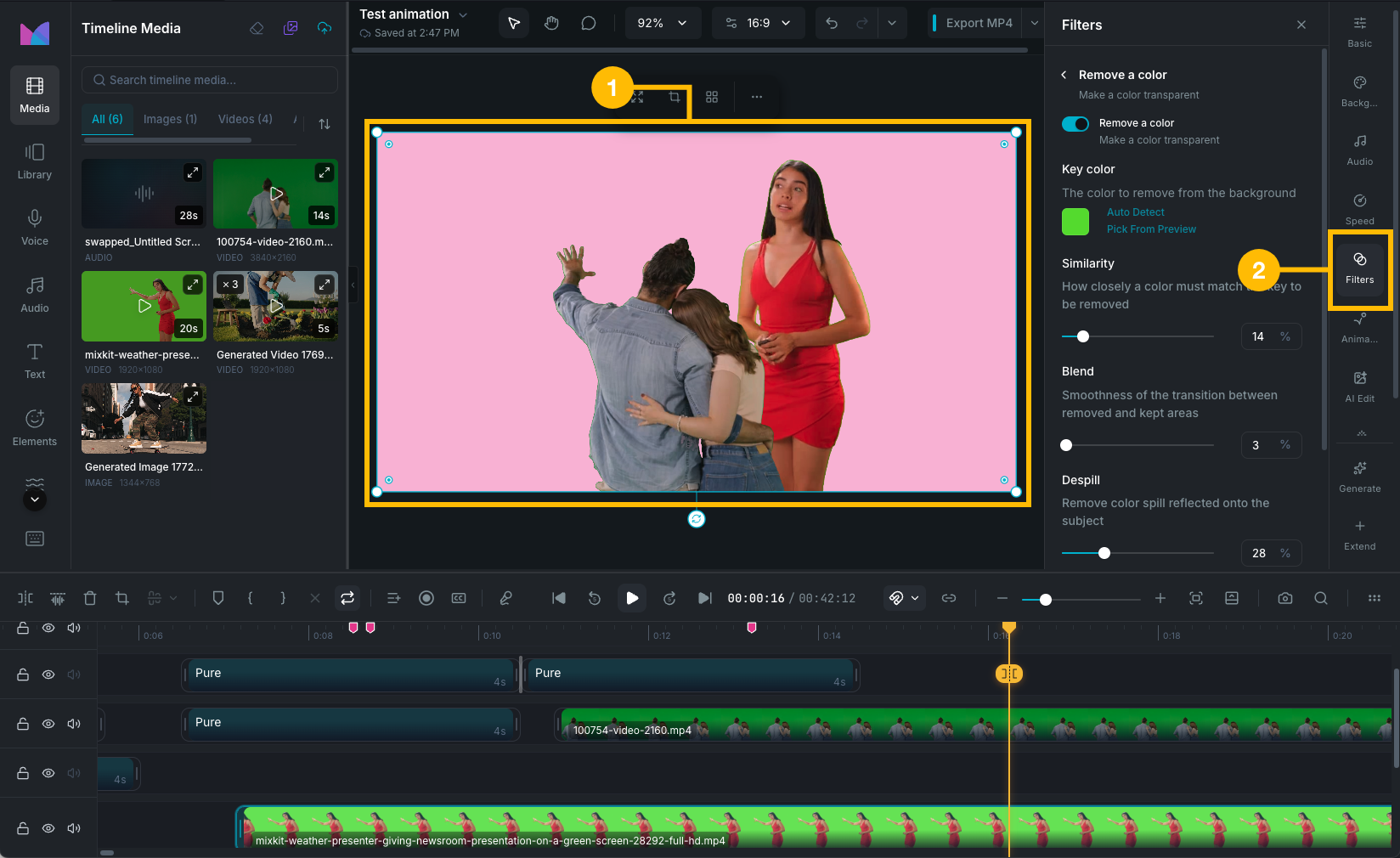
Select a video or image clip on the timeline, then open the Filters tab in the property panel and enable Remove a color.

Key color

The key color is the color that will be made transparent. When you first enable chroma key, Wayaframe automatically detects the dominant background color from the current frame.

You can change the key color at any time using three methods:

Auto Detect

Click Auto Detect to re-analyze the current frame. Wayaframe samples the edges of the frame, identifies the most common color, and sets it as the key color. This works best with solid, evenly-lit backgrounds.

Pick From Preview

Click Pick From Preview, then click directly on the canvas to sample a color from any spot in the frame. Use this when the background color isn't uniform or when Auto Detect picks the wrong color.

Color picker

Click the Key color swatch to open the color picker. Select a color visually or type a hex value (e.g. #00ff00 for green). The default key color is green.

Settings

Four sliders let you refine exactly how the keying is applied. All changes preview instantly on the canvas.

Similarity

Controls how closely a pixel's color must match the key color to be removed.

  • Range: 0 to 100%. Default: 18%.
  • Lower values: only pixels very close to the exact key color are removed. Use this when the background color is very consistent and you want to preserve similar colors on the subject.
  • Higher values: a wider range of colors around the key color are removed. Use this when the background has slight color variations, shadows, or uneven lighting.

Start low and increase gradually until the background is fully removed without eating into the subject.

Blend

Controls the softness of the transition between removed and kept areas.

  • Range: 0 to 100%. Default: 6%.
  • Lower values: hard, sharp edges between the subject and the transparent area. Can look jagged or harsh.
  • Higher values: softer, smoother edges with a gradual transition. Helps the subject blend naturally into a new background.

Increase blend if the edges of the subject look rough or pixelated after keying.

Despill

Removes color spill where the key color reflects onto the subject. For example, a green screen often casts a faint green tint on skin, hair, and clothing near the edges.

  • Range: 0 to 100%. Default: 28%.
  • Lower values: less color correction. Use if there's minimal spill or if despill is affecting the subject's natural colors.
  • Higher values: stronger correction that neutralizes more of the reflected key color. Use if you see a noticeable color tint on the subject.

Edge Cleanup

Tightens the edges to reduce fringing and halos around the subject.

  • Range: 0 to 100%. Default: 20%.
  • Lower values: preserves more edge detail but may leave thin fringes of the background color.
  • Higher values: contracts the edge of the matte inward, removing fringe but potentially clipping fine details like hair.

Adjust edge cleanup after setting similarity and blend to clean up any remaining artifacts.

Show matte

Toggle Show Matte to see the transparency mask instead of the final result:

  • White areas: fully visible (the subject).
  • Black areas: fully transparent (removed background).
  • Gray areas: partially transparent (edge transitions).

Use matte view to diagnose keying issues. If the subject has gray areas, increase similarity. If the background has white spots, decrease similarity or adjust the key color.

Compositing with a new background

After removing the background, the transparent areas reveal whatever is on the tracks below. To add a replacement background:

  1. Place an image, video, or solid color clip on a track below the keyed clip.
  2. The keyed clip's transparent areas show the background clip through.

The stacking order of tracks on the timeline determines what appears in front and behind.

Tips for best results

  • Even lighting: light your background as evenly as possible to minimize shadows and hot spots. This lets you use a lower similarity value for a cleaner key.
  • Distance from background: keep the subject away from the background to reduce color spill.
  • Start with Auto Detect: let Wayaframe pick the initial key color, then fine-tune with the sliders.
  • Adjust in order: set similarity first (to remove the background), then blend (to smooth edges), then despill (to remove color tint), then edge cleanup (to tighten any remaining fringe).
  • Use Show Matte: switch to matte view to see exactly what's being kept and removed before judging the final composite.

Reverting

Disable the Remove a color toggle to turn off chroma key. The clip returns to its original appearance. You can also use undo to step back through changes.

Wayaframe Help Center